

Lake Titicaca covers a total area of over eight thousand square kilometres. Its location at an altitude of around 3,800 metres also makes it the highest navigable lake in the world. However, when you look across the huge pond from the shore, it seems more like the ocean.
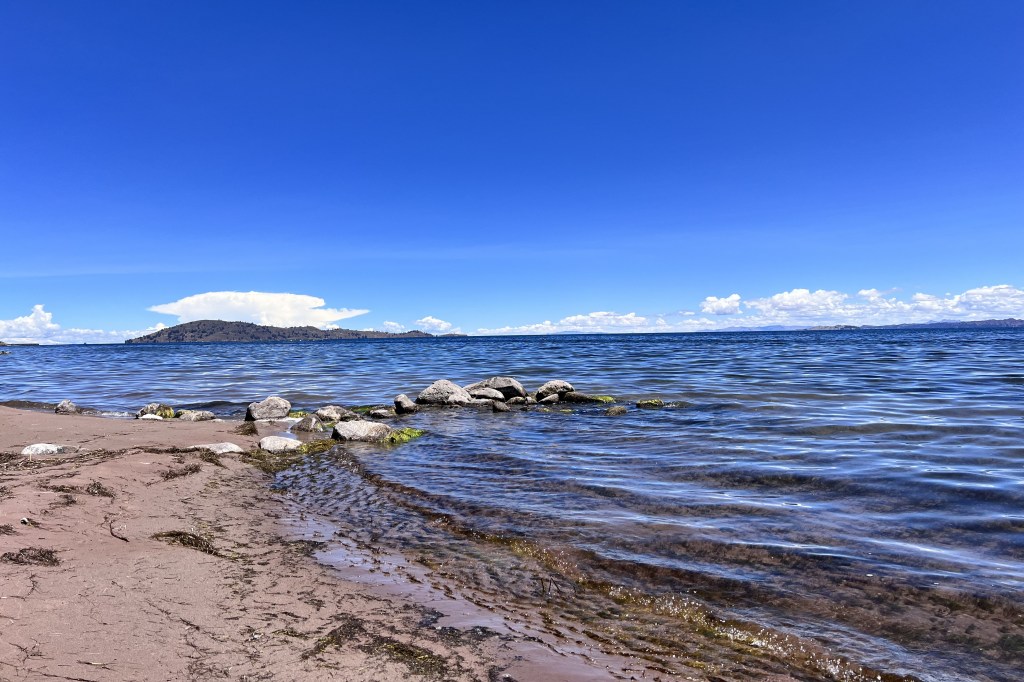
But the largest lake in South America is not only located on Peruvian territory. The national border divides it into a Peruvian and Bolivian part. However, I was first allowed to explore the waters on the Peruvian side. And so I travelled to the well-known tourist destination Puno.
The Arrival
In my post on my travel preparations, I already told you about the bus company that took me from one destination to the next within Peru and Bolivia. With Peru/Bolivia Hop, I travelled on from Cusco to Puno. As the journey takes a total of seven hours, we travelled overnight.
The section from Cusco to Puno was the first one I travelled by Peru Hop. So when I arrived at the bus station, I didn’t really know what to expect. To be honest, up to this point I had some doubts as to whether the organisation even existed. It all sounded a bit too good online.
Once I arrived at the terminal, I actually found a representative who explained everything to me. I was also given a fabric wristband and had to register in a list. And then we were ready to go.
The bus was very modern, with new, adjustable leather seats. Everyone was also given a blanket and a small pillow to ensure a good night’s sleep. There weren’t too many people on board, so almost everyone had a row to themselves.
So, my first experience with Peru Hop was very good, even if I couldn’t sleep very well despite the comfort. After all, it’s a bus and not a bed. In any case, everything went smoothly, and we arrived at our destination early in the morning, at around five o’clock.
The Accommodation
Fortunately, most hostels have a 24-hour reception, so you don’t have to wander the streets alone before sunrise. The only thing you might have to wait for is the check-in.
The bus took me straight to Inka’s Rest Hostel. I had to wait a while at reception until my bed was ready. I used the time to get fresh and collect my dirty laundry. Luckily, the hostel offers a laundry service. In fact, I never had to wash my own clothes during my two-month trip. In South America, it’s common for laundry to either be done by the staff themselves or taken to a local laundry by them. Now that’s what I call luxury 😉
The staff at Inka’s Rest were super helpful and I was able to check into my room before the official check-in time. However, as the people in my dorm were all still asleep, I just quickly put my things down before I started into the day.
At the reception of Inka’s Rest Hostel you will also find numerous offers for tours and the staff will be happy to help you organise your stay in Puno.
Day 1:
I used my first day in Puno mainly to explore the city itself. However, as I hadn’t slept too much at night and I was still exhausted from the hikes of the last days (Machu Picchu & Rainbow Mountains), I took it slow today. Or at least that was the plan.
After I left the hostel again, it was still quite early. First I headed towards the harbour. After all, I wanted to see Lake Titicaca first, of course. That was the main reason I had come here.
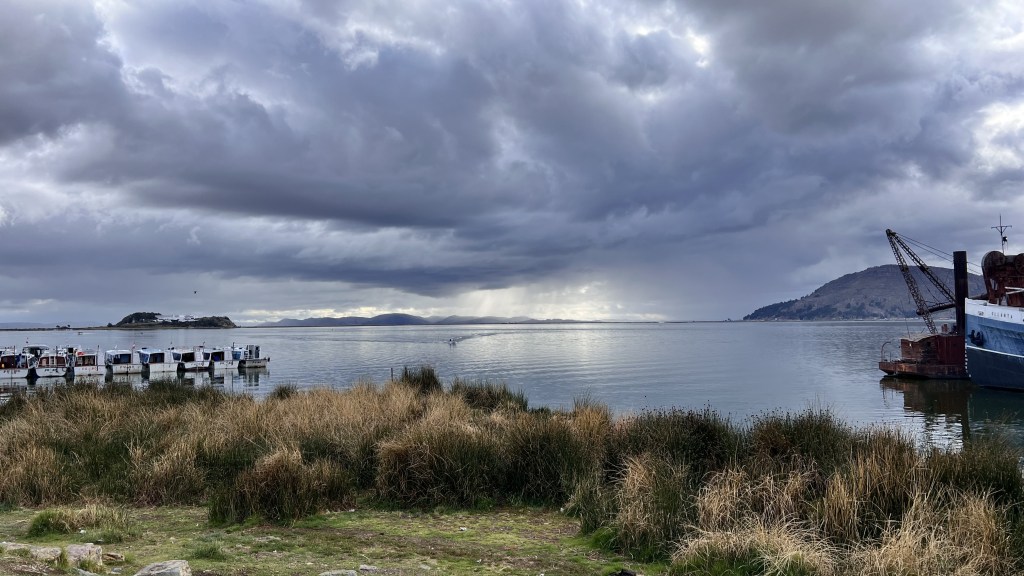
At Puerto Muelle Puno, you will not only find numerous boats and a small lighthouse, but also a few restaurants. My stomach was slowly starting to growl. I also felt the first raindrops from above, which is why I quickly found shelter in one of the eateries. There I had a delicious breakfast of fresh fruit juice and avocado bread.
Only when it had stopped raining again did I dare to go out again. I continued walking along the Avenida Costanera along the shore to the next harbour pier. The Puno sign is also located there. Then I continued towards the city centre. Avenida El Sol is the main commercial street in Puno. Here you will find many shops selling a wide variety of consumer goods, small restaurants and lots of street vendors.
Back towards the centre, the Mercado Central is located just near Inca’s Rest. It cannot be compared with the central market hall in Cusco. Nevertheless, there was also a large selection of fruit and vegetables available here. Puno also features the classic parks with pretty fountains surrounded by ancient buildings. The largest is the Plaza Mayor with the cathedral. Several ice cream shops invite you to try one of the many delicious flavours, such as at Helados Vizzio.

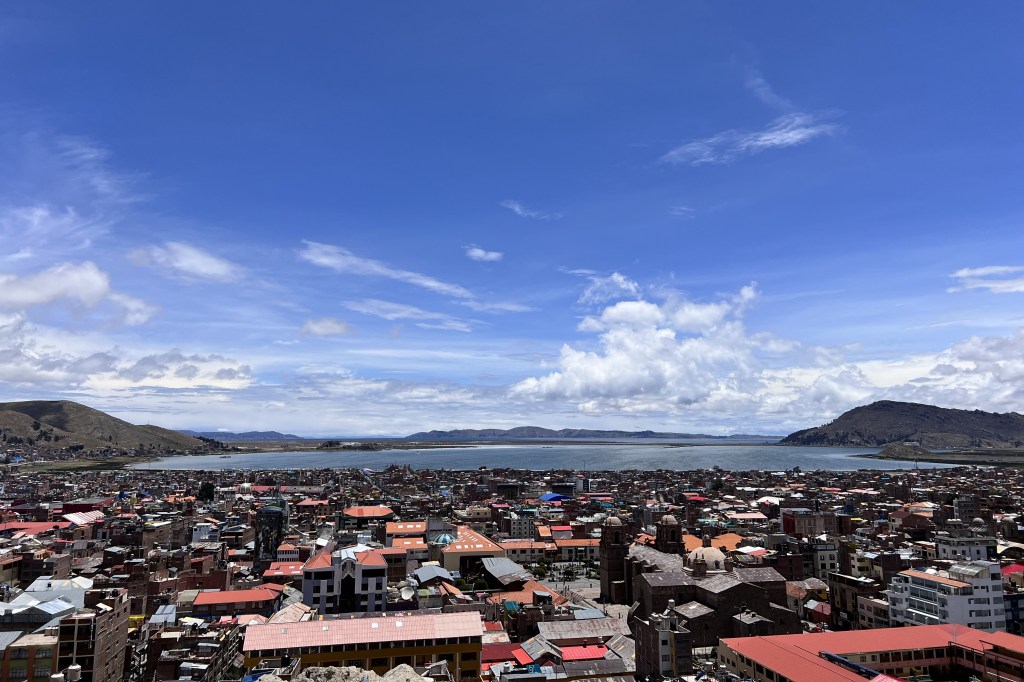
After having explored the city centre sufficiently, I wanted to take a look at the surrounding area from above. Fortunately, Puno has several miradores, i.e. viewpoints, from which you can enjoy a great panorama of the city and the lake.
As determined as I am, I of course wanted to head for one of the highest peaks straight away. So much for ‘I’ll take it slow today’. The Mirador del Puma is located at the northern end of the city. However, after walking a bit, I quickly decided it might be better to head back. Firstly, there were hardly any people around in this part of town and I didn’t know how safe this area was. Furthermore, with my sore muscles, a reminder of the last days‘ hikes, it wasn’t easy to climb the rather steep streets. You also have to remember that Puno is 3,800 metres above sea level, which is even higher than Cusco. Therefore, here too, you quickly run out of breath if you make just a little effort.
And so, I made my way to the Mirador Manco Capac on Cerrito Huajsapata. The small hill (Cerrito) rises in the middle of the city centre, close to the main square. From here you also have a great view over the city and the entire riverbank. You should definitely visit a viewpoint to get a better idea of the dimensions of Lake Titicaca.
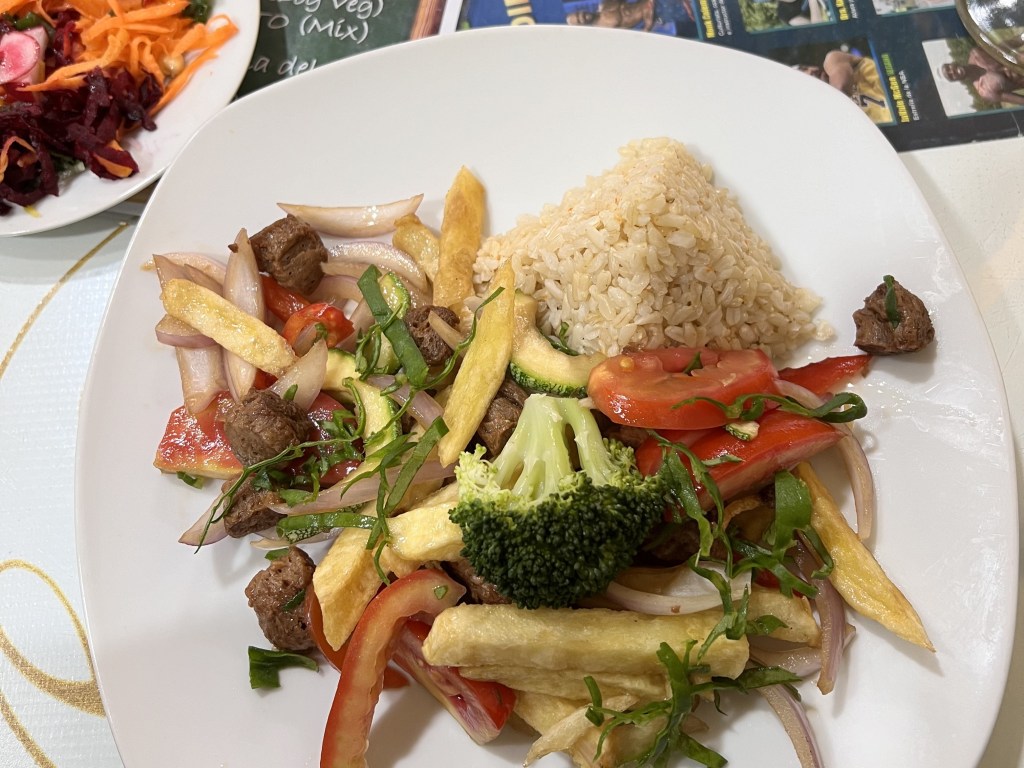
After my quite strenuous city walk, I finally had lunch at Loving Hut Vegan. As the name suggests, vegan dishes are served here. There aren’t many places like this in South America, but they do exist. At Loving Hut Vegan, the menu is not only exclusively vegan, but also features traditional Peruvian dishes, just without meat. For little money, you can enjoy a lunch menu with soup, salad from the buffet, main course and a small dessert, as well as a drink. For my main course, I had lomo saltado, a typical dish that is usually prepared with beef, here with soya meat. It’s not quite the same, of course, but it’s a good option for vegans who love to experiment.
After dinner, all I could think about was my bed. You have to put yourselves into my shoes: Sleepy, still exhausted from the last few days, on my feet all morning and my stomach filled with delicious food. Travelling can also be super tough. That’s why I went straight back to the hostel afterwards to get some well-deserved sleep.
In the evening, I met my bed neighbour. A nice German guy who had just started travelling himself. He was also currently travelling on a similar route to mine and so we would be running into each other again at our next two destinations.
Day 2:
On my second day in Puno, I had to get up early again. After a great breakfast at the hostel with yoghurt, bread and pancakes, I was picked up by the shuttle service and taken to the harbour. That’s where my day trip to the floating islands on Lake Titicaca started.
I booked the tour directly through Peru Hop. However, you can also organise it on site, for example at your hostel. For around thirty dollars, you can spend the whole day exploring with a guide and visiting several islands, with a delicious lunch included.
It was here that I noticed that many travellers seem to be following similar itineraries. At the harbour, I met three German girls again who we had already bumped into on our hike to Machu Picchu. They say you always meet twice in life. In future, I would often encounter people a second or third time.
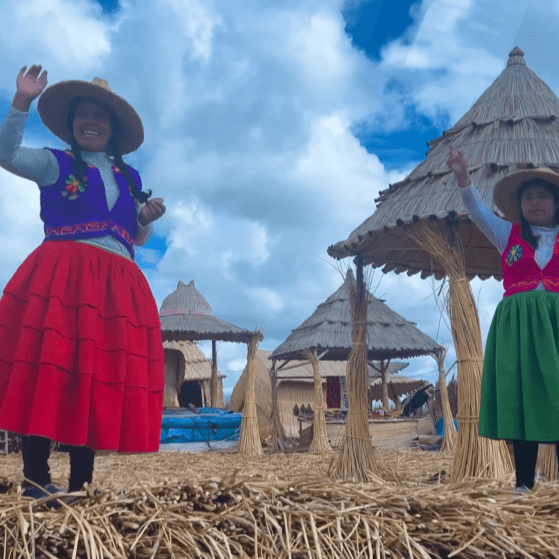
Our first stop were the floating Uros Islands. These islets did not develop naturally, but were built by the indigenous people of the lake, the Aymara, themselves. Entire villages were constructed on land made from totora reeds.
The Aymara originally lived mainly from fishing. On land, the catch was then exchanged for other food and goods. Today, however, the society benefits greatly from tourism. You can tell that. As soon as we arrived on the first island, we were greeted by three women who sang for us. On the islands, we were given a brief introduction to life on the islands and were then invited into the homes of the inhabitants. Small huts made of straw, in which no more than a small bed fitted. We were even allowed to try on their clothes and take photos in them. There were also some souvenir stalls and we were told that they had recently been equipped with the first black and white televisions. Later, three little boys sang a song for us. This all seemed a bit suspicious to me.
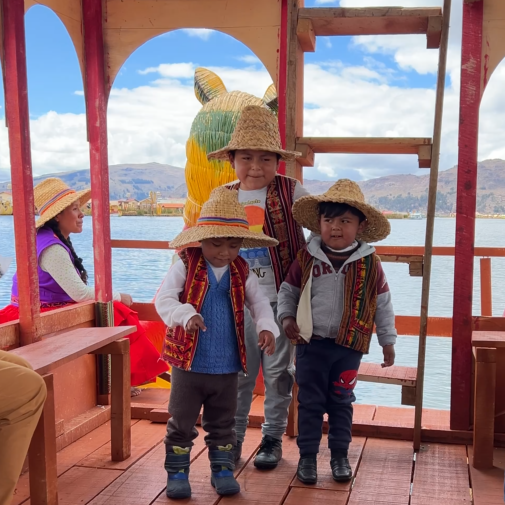
In the evening at the hostel, we researched on Google how much of the stories are actually true. We found a source that said that today nobody actually lives on the islands anymore and that they serve only as tourist attractions. However, since then I have also seen documentaries in which it appears that the islands are actually still inhabited. They even have their own school where the Aymara language is still taught.
One thing is certain: the islands were built by humans. Far from any civilisation, the Aymara found shelter on the great Lake Titicaca. The two islands we travelled to next were even used as high-security prisons during the Spanish colonial period due to their remote location.
The boat trip was a highlight in itself. I made myself comfortable on deck with a guy from Peru and enjoyed the nice weather and the view of the beautiful landscape.

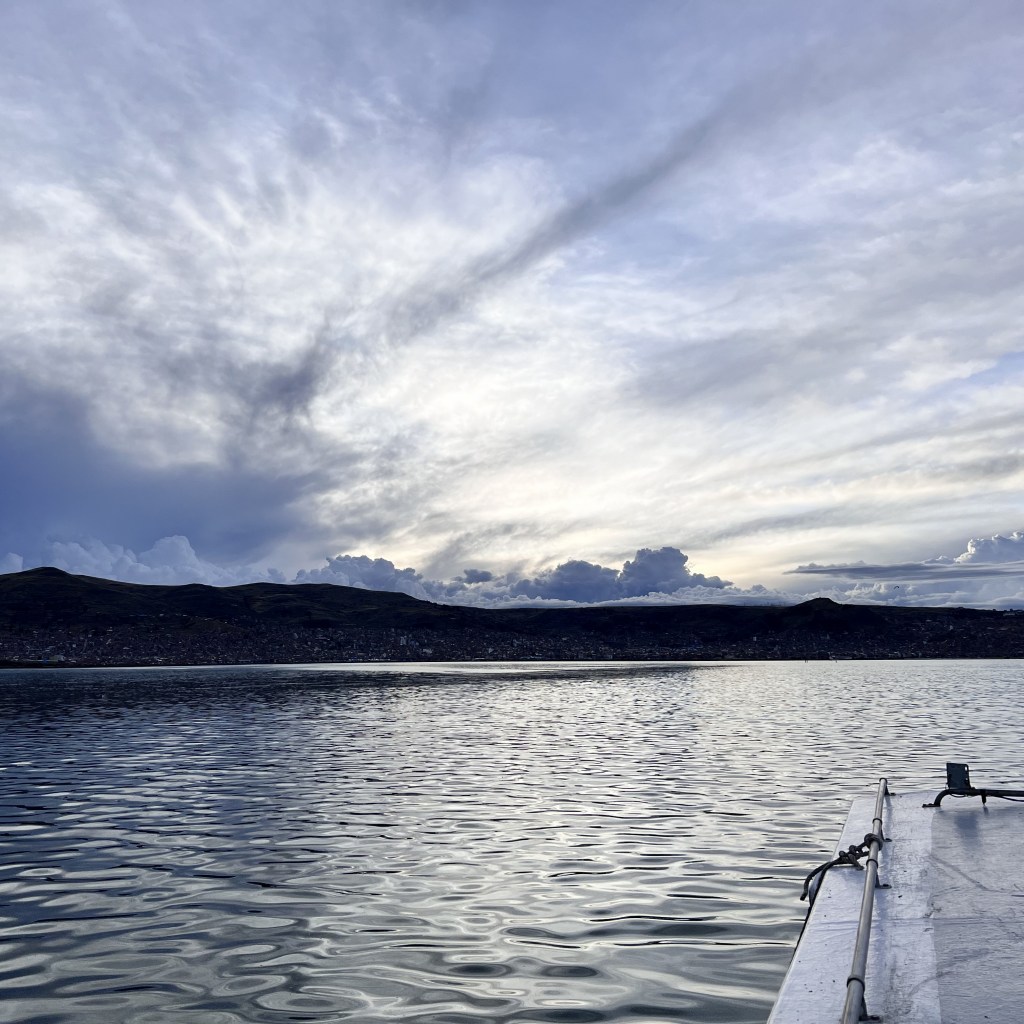

Once we arrived on Llachon Island, we took a short path up the hill to a small restaurant with a great view of the lake. There we were treated to some delicious fish.
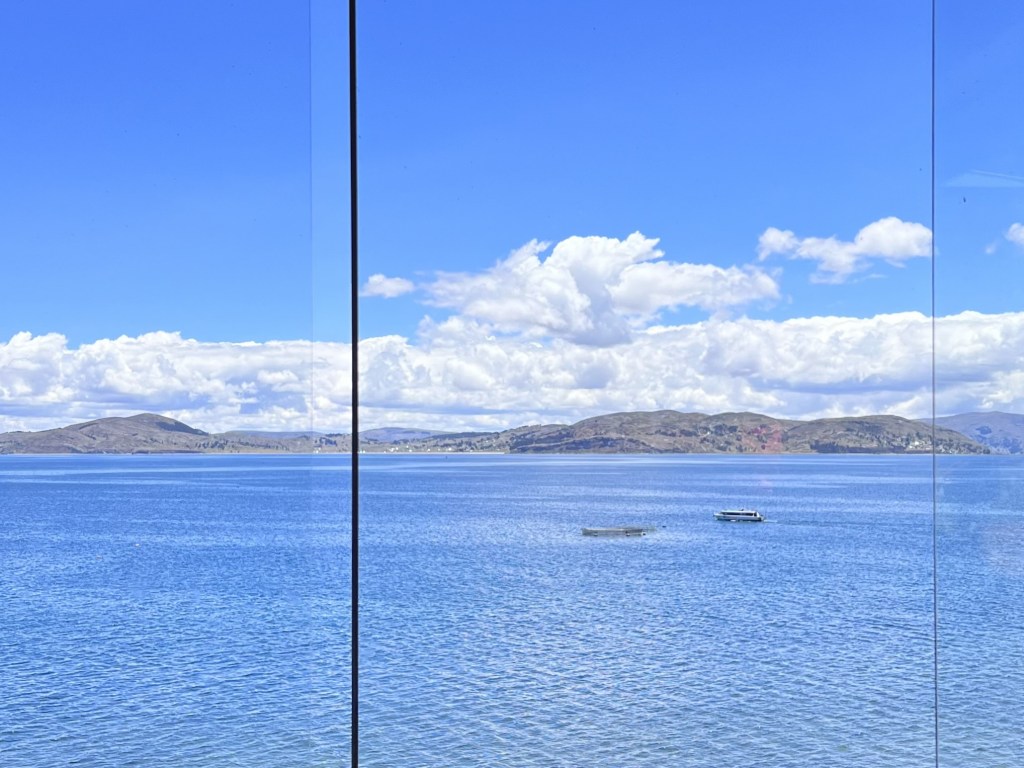
After lunch, we had some time to digest. To make sure the food stayed in our stomachs during the boat ride. Some of us used the time to go for a swim in the lake. However, the temperature should not be overestimated.

We then headed back on board and towards Amantani Island, where we took a stroll and learnt more facts about life on the islands. Some of the tour participants stayed behind on this island. This is because there is also the option of extending your stay and lodging with an indigenous family for one or two nights. During this home stay, you can immerse yourself even more deeply in the culture and become part of the family for a short period of time.
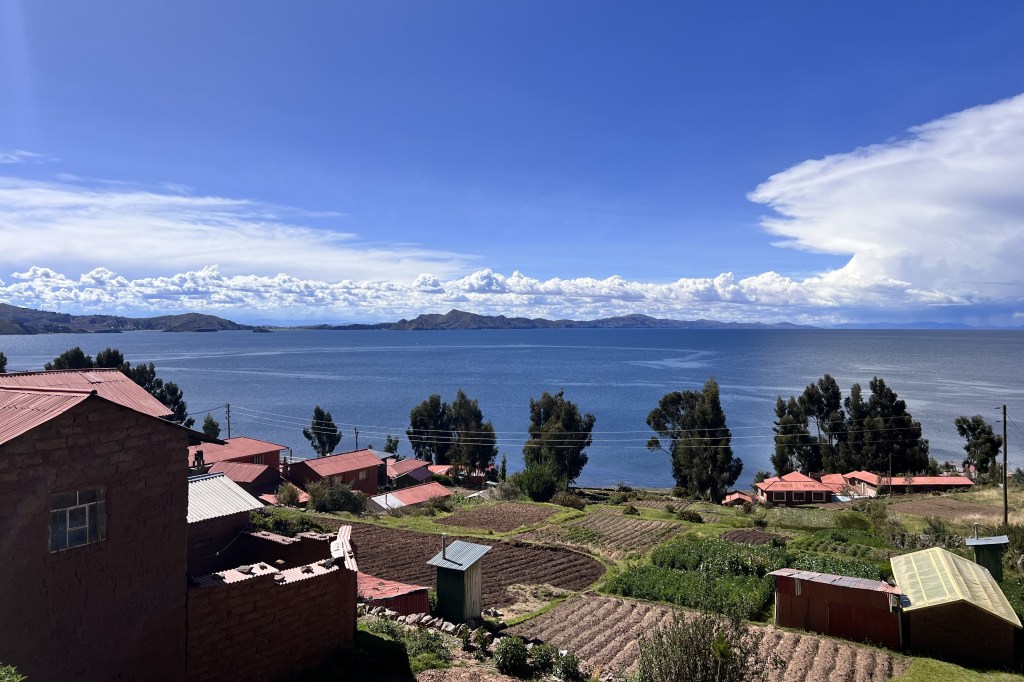
For me, however, it was time to head back. We arrived back in Puno in the early evening.

A quick fact in between: ‘Titi’ translates from the Aymara language to big cat or puma. ‘Kaka’ is the rock. ‘Titicaca’ therefore means something like ‘the rock of the puma’ and is due to the shape of the lake, which looks a bit like a puma chasing a rabbit.
Back at the hostel, I met my German room mate again, who was doing the same tour that day but with a different operator. I also bumped into the British girl I met on the hike to the Rainbow Mountains. She happened to be staying in the same room as me. (You always meet twice 😉 ).
All together we went out for dinner. Before that, however, we had to freshen up a little. That’s when I first discovered that it’s not uncommon to get food poisoning in Peru and Bolivia. The walls between the bathrooms were very thin and I could hear a girl vomiting her guts out in the room next to mine. Now I would be a bit more careful when it came to food.
In the end, we decided to have pizza. Not too much can go wrong here. You won’t get an authentic Neapolitan pizza at the Restaurant Pizza Andina, but the food is quite good and is accompanied by Peruvian panpipe music. Most importantly, with each order you get a small free pisco sour. If you haven’t had enough, you can pop into the Peru Bar Puno afterwards. There you can get a super delicious triple tequila for the price of a single.
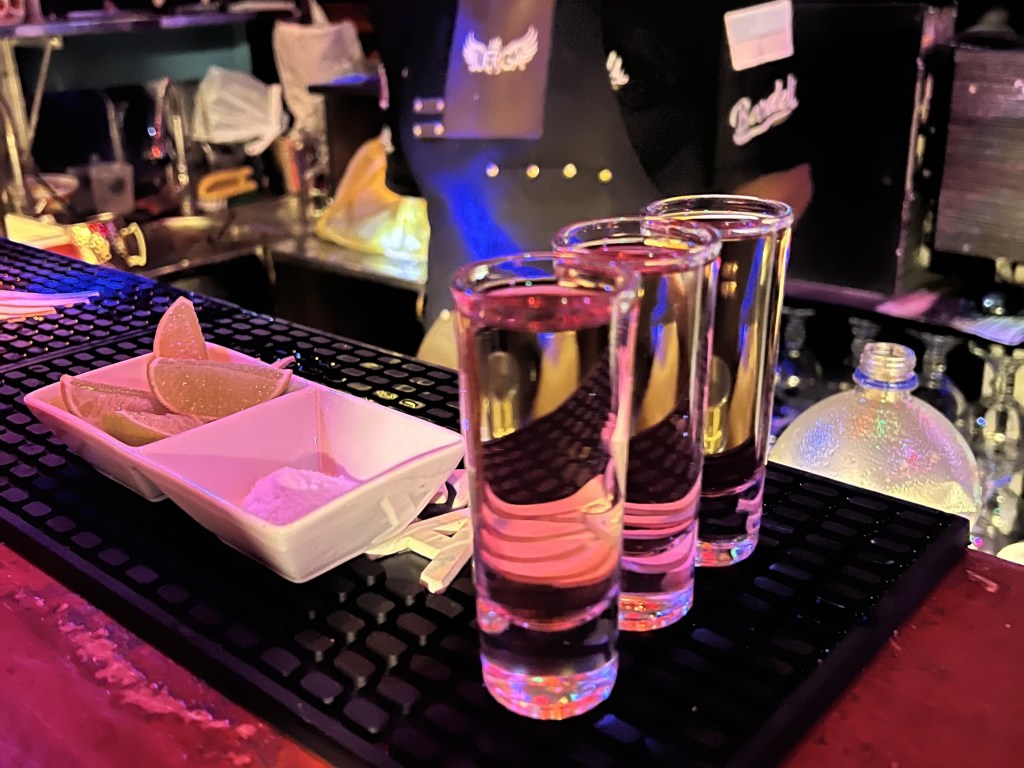
But the night wouldn’t last too long. After two pisco sours and a triple tequila shot, it was time to go to bed. The next morning I would be moving on to my next destination.
My conclusion
When in Peru, and if you have enough time, you should definitely visit Lake Titicaca. After all, it is extremely fascinating to find such a huge body of water at such a high altitude.
Of Puno I would have expected more. After my stay in Cusco, the city seemed rather shabby, and I felt a lot less safe. Fortunately, I was in good hands at Inka’s Rest Hostel.
It was also interesting to learn more about the indigenous people and life on the islands. However, during the tour I often wondered how much of this was for real and which stories and facts were actually true.
In the end, I definitely learnt a lot of new things. And if you’re at Lake Titicaca, you should definitely take a boat tour. I’ve also heard of many positive experiences with home stays on the islands. This perhaps makes the experience a little more authentic.
However, two nights in Puno were enough for me and so I continued along the shore to my next destination on Lake Titicaca. To a place that I’m sure many people have never heard of before. You’ll find out where I ended up in my next post. Until then,
Bussi Baba!
 Bussi Baba
Hinterlasse einen Kommentar