
You could stay in Cusco for weeks if you were to discover all the hidden treasures around this city in the Andes. Unfortunately, after my two-day trip to the Inca city of Machu Picchu, I only had one day left. And on this day, I was supposed to visit the famous Rainbow Mountains.
The Arrival
I booked this tour with the organisation Machu Picchu Reservations, with which I had already climbed Machu Picchu before. Two other people from my two-day hike were also joining me again. Other than that, we were a mixed bunch. This time there were fewer couples, and more young solo travelers like me.
The drive from Cusco to the Rainbow Mountains normally takes around three and a half hours. However, due to road closures, we were on the road for almost five hours each way that day.
Thankfully, we made a short stop for breakfast on the way there. In a small restaurant, a buffet with plenty of food was prepared for the whole group. So while we fuelled up for the upcoming hike, we were able to get to know each other a little better. A nice British lady was sitting opposite me. I also got some company from home again on this trip from Cusco. For the second time during my first week of travelling, I met a girl from Vienna. Such a small world we are living on.
The journey then continued. Our guide gave us the choice of driving directly to the Rainbow Mountains and hiking just a little way up to the view point or first doing a short trek through the valley where the colourful mountains are located. We decided to do the hike through the Red Valley.
Hiking through Red Valley
Right at the beginning, we realised that this trek was not to be underestimated. Although we didn’t have to pass any extremely steep slopes, a hike at such an altitude was very demanding. For the first time, I also realised how this extreme altitude can affect the body. Apart from the headache, I felt a bit nauseous and light-headed.
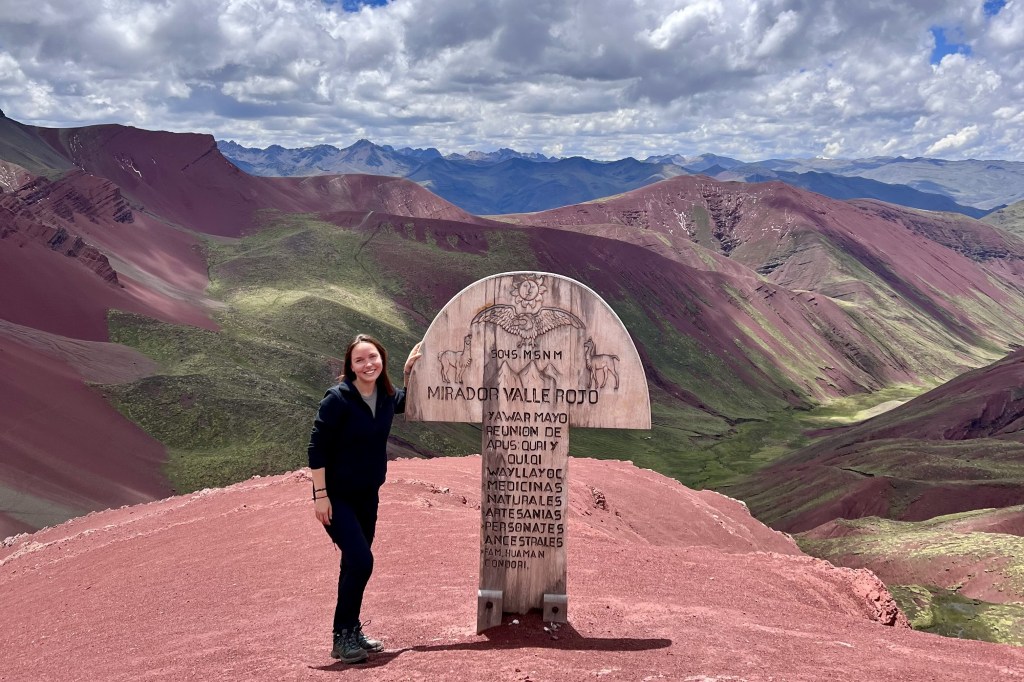
So if you’ve never heard of altitude sickness before, you’ll experience it first-hand at four to five thousand metres. How your own body reacts varies from person to person and also depends on the day. In any case, you should always listen to your body, otherwise a hike along steep slopes can quickly become dangerous.
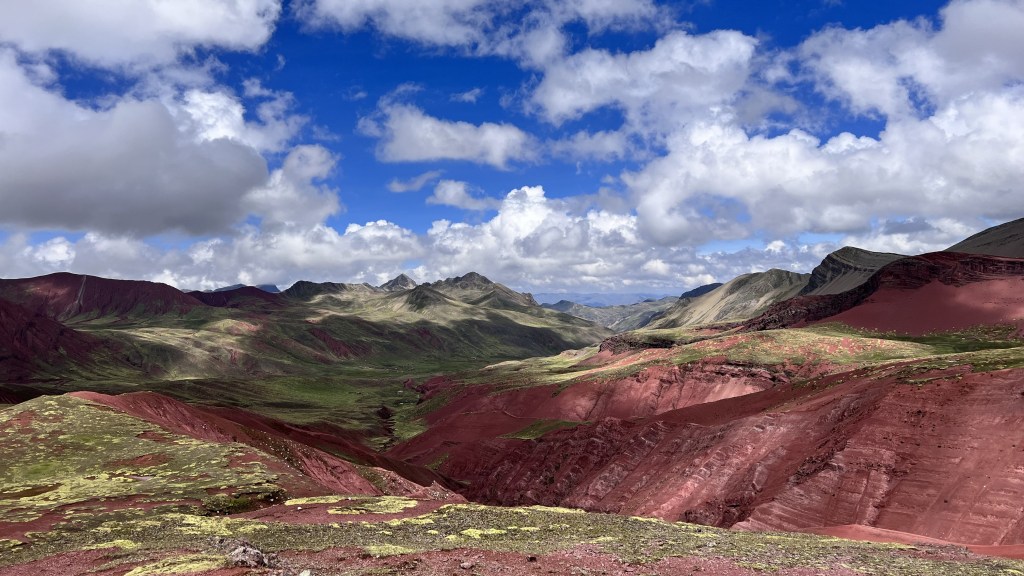
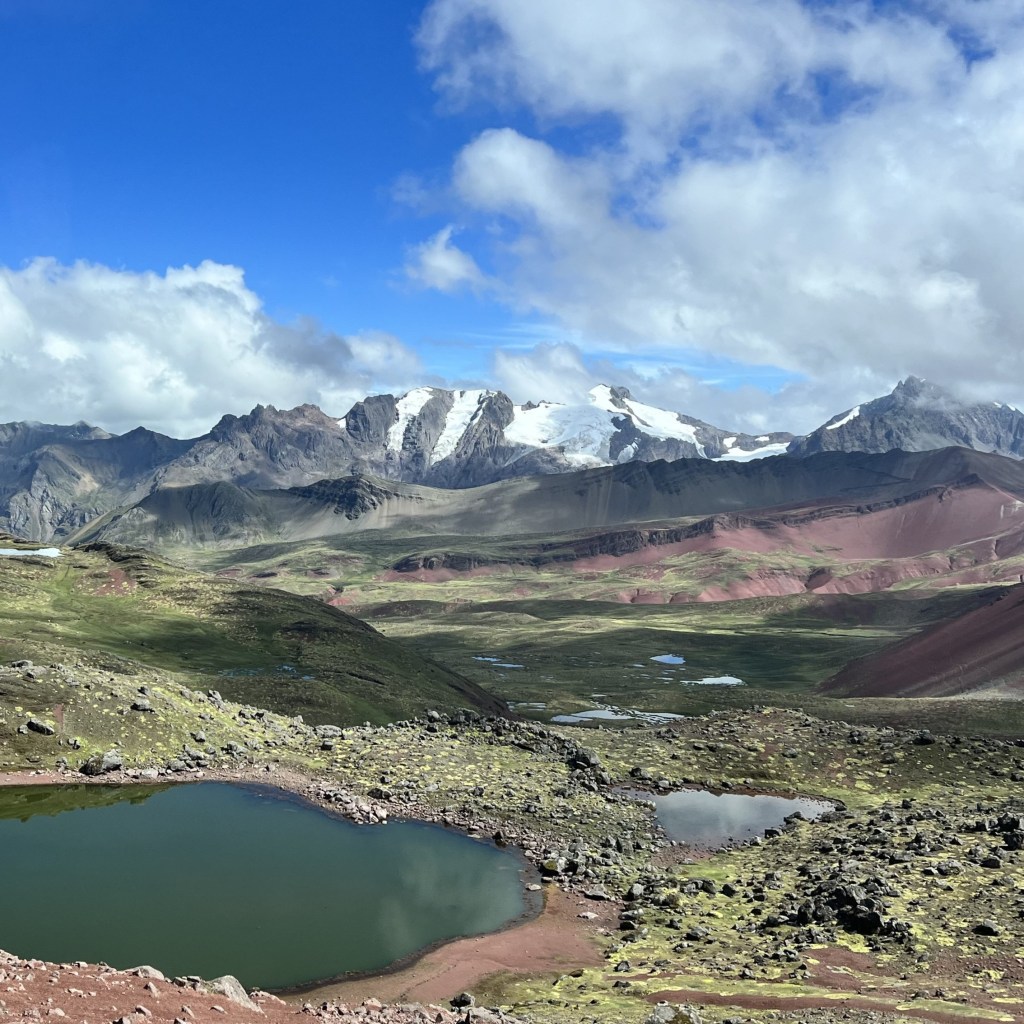
But even though this trek is extremely exhausting, it is definitely worth taking this one-hour diversions. Rarely have I seen a landscape as fascinating as this one. My eyes couldn’t get enough of the reddish mountains with bright green patches of grass in between. In hindsight, I would even say that the hike through the Red Valley was more impressive than the Rainbow Mountains themselves.

Coca in Peru
I have already mentioned in my article on Cusco that the cultivation of the coca plant is still legal in Peru and some other South American countries. Unfortunately, the production and trade of cocaine is still a huge problem. However, the leaves themselves actually have many health benefits. For example, they also help with altitude sickness.
Even the Incas regularly consumed this traditional medicine. Large parts of the empire were built in the Andes. A remedy for nausea, headaches and dizziness was therefore very helpful at these altitudes. Instead of swallowing the leaves, they were put into the mouth and chewed on. This is why many old illustrations show people with a puffy cheek from chewing the coca leaves in one side of their mouth.
The alkaloids contained in the leaves, the best known of which is cocaine, are released in small doses during chewing. On the one hand, this causes the blood vessels to tighten, which in turn promotes the supply of oxygen throughout the body. On the other hand, it provides energy and thus reduces the fatigue and headaches caused by the altitude.
The dried leaves don’t taste particularly good. I tried them plain for the first time in Bolivia. Since my arrival in Cusco, I have regularly drunk coca tea as a preventative measure, which is actually not that bad. On our hikes we also often ate candy, which obviously tastes mainly of sugar.
On our way through Red Valley, however, a guy from the Netherlands had some passion fruit-flavoured coca leaves with him. Especially in Bolivia, the leaves are sold in different flavours. He let us try them and they were actually really delicious. And perhaps they also helped a little with the nausea.
The Rainbow Mountains
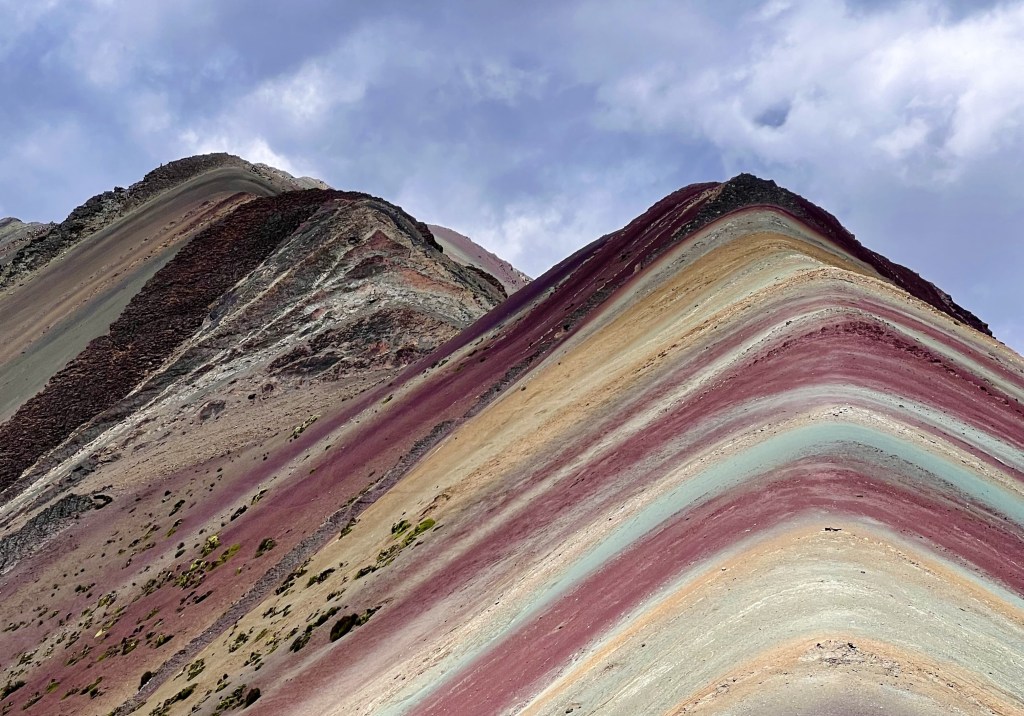
The last section to the viewpoint in front of the famous mountains in the colours of the rainbow, also known as „Montañas de Siete Colores“ (mountains in seven colours), was probably the hardest. This first peak could only be reached via an extremely steep trail with handrails to hold on to.
From the top, you had the classic view of the mountains and lots of other tourists. Although the sight was only discovered a few years ago because it was covered in snow before, it has been attracting hundreds of tourists every day ever since. The infrastructure is accordingly good. You will find everything your heart desires on this narrow hill: food, beer, souvenirs and llamas with sunglasses for taking pictures. Please note: Money is usually charged for these animal selfies.


If the first ascent wasn’t enough, you can hike up to the highest point, which sits at an altitude of just over 5,000 metres.
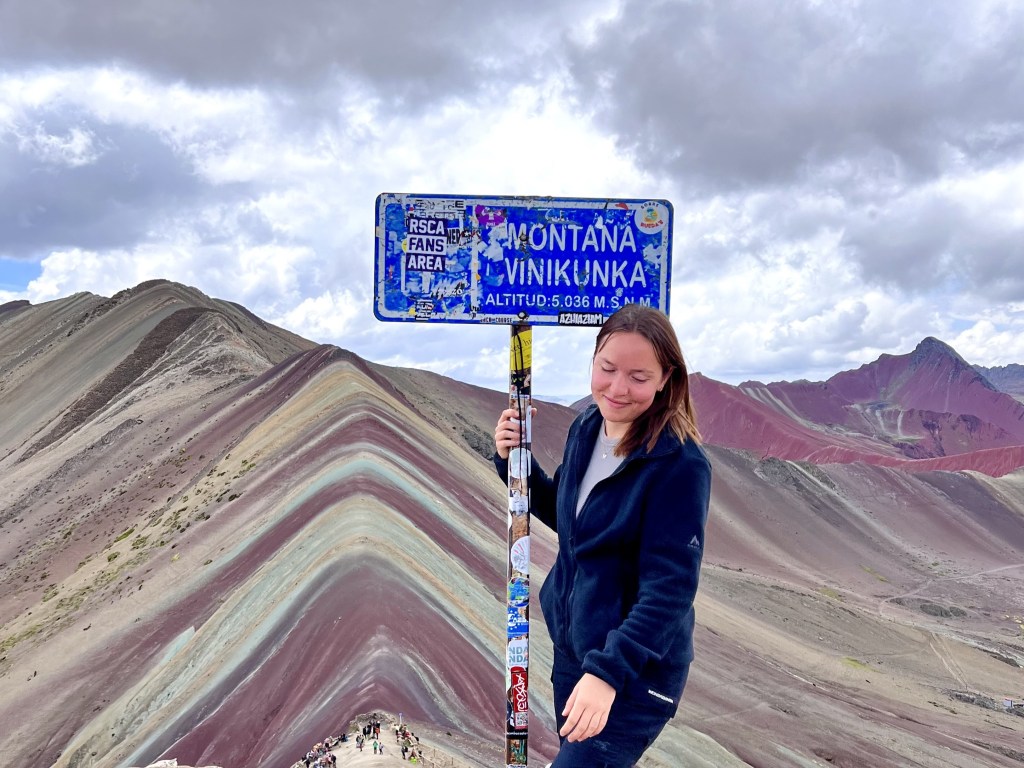
With many short breaks to catch my breath, I actually somehow managed to conquer this mountain. It was definitely worth it though. My new Viennese friend took such a perfect photo of me that it looks like we were all alone up there. The other tourists seemed to have disappeared without a trace.

But now let’s talk about the mountains themselves. You may be wondering how this colourful colouration occurred in the first place. Well, the layers of colour are the result of a mixture of sedimentary rock containing minerals such as iron oxide (red) and copper sulphate (green). The fourteen colours have developed over the years as a result of sedimentation, weather and oxidation.
The Weather Conditions
Like all parts of Peru, it is of course best to visit this attraction during dry season between March and November. In the remaining months, the weather can often be very inconsistent, fluctuating from sunshine in one moment to rain and snowfall in the next. At night, temperatures can drop below zero degrees.
The recommendations on what to take with you on this excursion therefore usually include a hat, scarf and thick jacket. We didn’t really need any of this. However, people who were in the same place a few days earlier or later needed three layers of clothing, including a winter jacket. So don’t underestimate the cold.

Although the weather conditions were almost perfect on the day we were on the trip, we were still a little concerned. On the outward journey, a few people from the group told us that a severe storm had supposedly hit the mountains the day before. During the day, it suddenly started to thunder and hail out of nowhere. And according to the stories, one person was even struck by lightning.
Of course, we then also went up the mountain with a slightly uneasy feeling in our stomachs. Many of those who had already heard the news before departure cancelled their bookings immediately. For me and many others in the group, the news came as a surprise and so there was no turning back.
For this reason, we didn’t spend too much time at the viewing platform. After all, we had to walk all the way back through Red Valley. On the return trip, we slowly saw thunderclouds gathering. Whilst some of us were hardly worried, we two Austrians, who were holding on for dear life, sprinted ahead to get to the car as quickly as possible.
In the end, however, everything went well. Only the Dutch guy, who was actually travelling with the Viennese girl, was a bit jealous. After all, she almost only had eyes for me the whole tour. It’s always nice to find a piece of home on the other side of the world and to be able to talk to someone in German.
During the drive back, it did start to rain and, if I remember correctly, it even hailed a little. However, the thunderstorm didn’t reach the same extent as the day before. Thank goodness.
Along the way, we stopped at the same restaurant as for breakfast. And once again there was a buffet. But this time with hot dishes for lunch. After all, we were all starving. The food was also extremely delicious. Unfortunately, another side effect of altitude sickness is a reduced feeling of hunger.
For dinner in Cusco today I just grabbed a small street food snack. Papas Rellenas are similar to Austrian croquettes, except that they are filled. Usually with egg and vegetables or meat. My vegetarian stuffed potato (translates to „Papas Rellenas“) came with a fried vegetable rice. Cheap and super tasty at the same time. People with sensitive stomachs should perhaps just be a little careful with street food. I never had any problems in Peru, but you can never completely exclude the possibility of food poisoning.
My Conclusion
If you have planned some extra time in Cusco, I would definitely recommend taking a tour to Rainbow Mountains. Just make sure that a short hike through the Red Valley is included. As I mentioned above, I personally found this part of the excursion to be almost more fascinating than the Montañas de Siete Colores themselves.
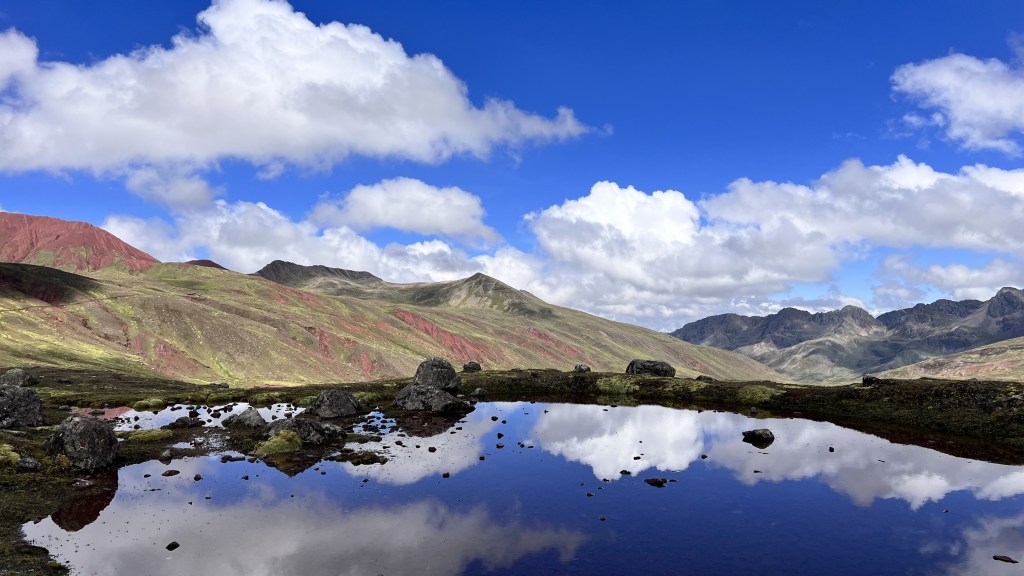
To be honest, when I stood in front of them myself, I was a little disappointed. After the bright colours in the Red Valley, the mountains almost looked a bit grey. I have to admit that I had to use filters myself to make some of the pictures look better.
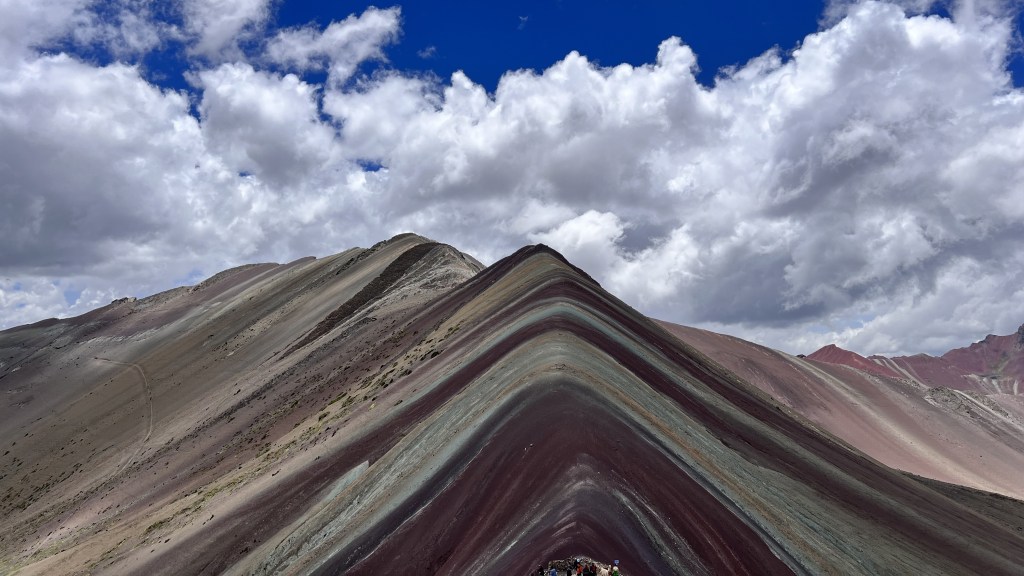
The place is also crowded with tourists, unlike the trail through the Red Valley, where our group was completely on its own. So, you have to queue for a great photo. Nevertheless, the Rainbow Mountains are very beautiful, and it is particularly interesting to learn how they formed.
After my tour, I didn’t go back to The Sleepy Mouse Hostel this time. I would spend the night on the bus to my next destination. You’ll find out where I was going in my next post. Until then,
Bussi Baba!
 Bussi Baba
Hinterlasse einen Kommentar